
Trace Former Carroll County Owners Transfer by Transfer
Build the backward chain from one confirmed current deed. Treat each earlier transfer as its own row. That habit keeps former owners, dates, deed types, and book references together, and it stops a name-only jump onto the wrong parcel.
| Transfer point | Grantor to grantee | Instrument | Reference to save |
|---|---|---|---|
| Newest conveyance | Seller to current grantee | Recorded deed | Date and book/page or instrument number |
| Prior acquisition | Earlier seller to that grantor | Warranty, quitclaim, executor, or other deed | Legal description and prior-deed citation |
| Earlier book entry | Former parties in the index | Deed-book record | Volume, page, and spelling |
| Plat connection | Prior tract to lots | Recorded plat and deeds | Map book, lot, block, and exceptions |
Treat the table as a research log, not proof that every row sits online. The online deed index has no confirmed starting year.
Walk the Carroll County Deed Chain Backward
The Clerk online-records page routes searches to eCCLIX. Private users face a limit of personal Carroll County use and five searches per day. Search both sides of every transfer. A former owner appears as grantor on one deed yet as grantee on the deed that conveyed the land in the first place.
- Find the current deed and verify its parcel clues and full legal description.
- Record the grantor, who is the immediately prior owner in that transfer.
- Search that name as grantee to locate the earlier acquisition.
- Compare exceptions, acreage, lot, and prior-reference text.
- Repeat until the online index stops, then continue in office or archival volumes.
- Grantor
- The party conveying the interest.
- Grantee
- The party receiving it.
- Reverse index
- An index used to find a party in the opposite deed role.
- Chain of title
- The ordered instruments affecting the same land.
Match Carroll County Former Owners by Legal Description
Old Carroll County deeds describe land in many ways. Lot and block, subdivision plats, acreage, metes and bounds, river or landing references, and earlier-deed citations all appear. A street address is only a locator. The legal description defines what a deed conveys.
Compare every reservation, life estate, correcting deed, trustee capacity, and less-and-except clause. Near the Ohio and Kentucky River confluence, older orientation leans on waterways, roads, and tracts. PVA and GIS records can bridge the text. A parcel polygon never replaces it.
Note: A same-name hit is not a former owner until its land description matches the Carroll County parcel.
Verify How Far Carroll County Ownership Records Go Online
The online deed index lists no confirmed first year. Use the county availability selector, or ask the Clerk which instrument classes and years are searchable. A blank result does not disprove an older conveyance.
Coverage limit. The online cutoff is an open question. Continue prior-owner research in deed books, microfilm, and archival holdings.
The office at 440 Main Street is the direct fallback. Bring a grantor or grantee name, an approximate date, an instrument type, the legal description, and any known book/page. Confirm service needs before visiting.
Carry Older Carroll County Owners to KDLA
The Kentucky Department for Libraries and Archives guides cover deed, land, county, probate, and court records. Requests carry an initial $20 in-state fee and $25 out-of-state fee, plus copy or postage costs, with a four-to-six-week estimate. The guides page shows the fallback. Turn there when a volume is not online.
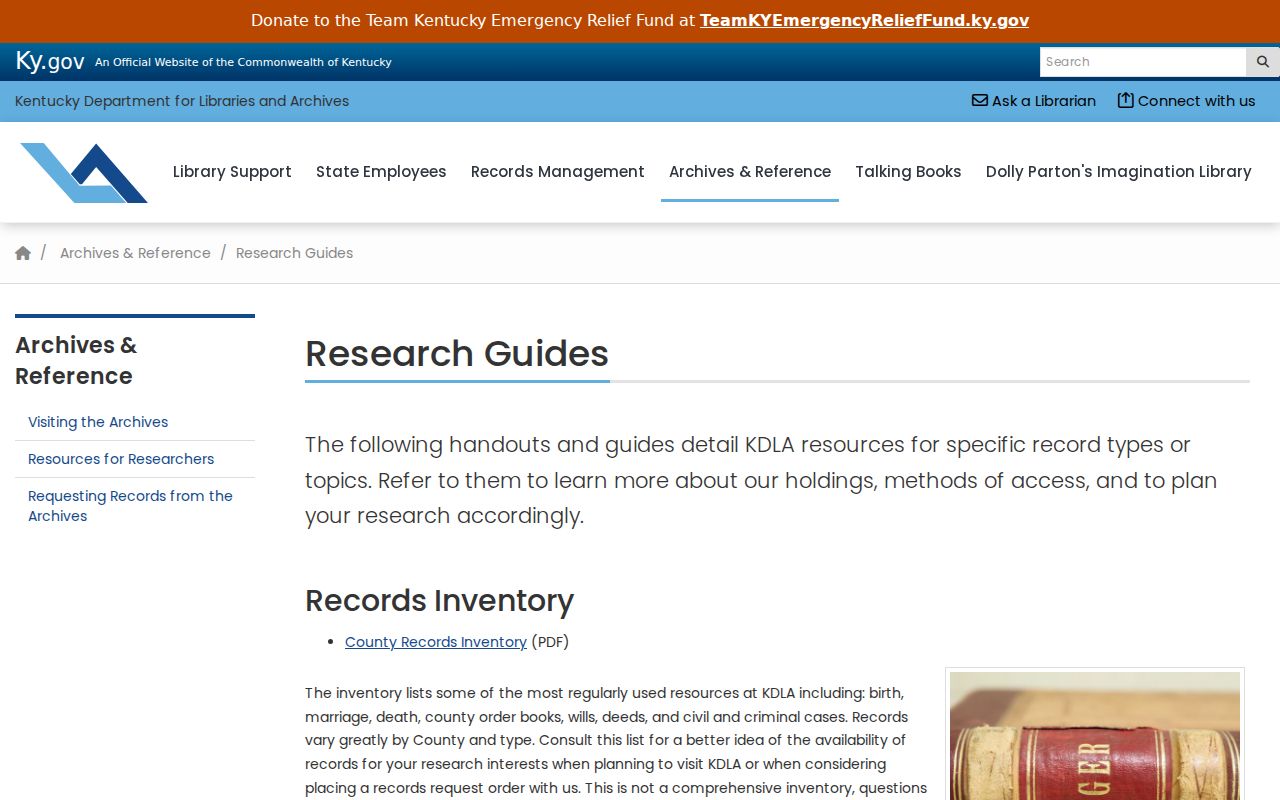
The guide is an entry point, not proof of a Carroll County book span. Send names, dates, record type, and every volume clue you have.
Ask What the Carroll County Microfilming Grant Preserved
A 2024 county audit reported a $25,103 KDLA local-records microfilming grant. It went to the Clerk office. That sum is a preservation clue only. The audit names no series, volumes, years, or viewing location. Ask which deeds, probate books, tax records, or order books were filmed. Ask where the film sits, courthouse or archives. A grant is not full digitization. A preserved roll and a searchable online image are different forms of access.
Reconnect Carroll County Chains Broken by Estates
A tidy seller-to-buyer chain can appear to stop when land passes through an estate. The Clerk holds wills and probate orders. The Circuit Clerk may hold the case file. A will names heirs but does not prove title. Look for representative authority, an executor deed, a probate order, or a later conveyance. Keep capacity words such as trustee, executor, administrator, and heir exactly as written.
Use Historic Carrollton Addresses as Ownership Leads
National Park Service material on the Carrollton Historic District lists historic owners and addresses. That material can seed a house history. Confirm the record concerns Carrollton, Kentucky. Districts with similar names elsewhere create false matches. Move from the old address to the current PVA or GIS parcel, then back through Clerk deeds. Designation material is context, not title evidence.
Lawful research. Use former-owner records for house history, estate work, and property diligence, never to track or harass a living person.
Request Carroll County Former-Owner Records by Every Available Channel
If eCCLIX stops short, use the Clerk counter or send a focused request by hand, mail, fax, or email under office policy. Give both name spellings. Add the date range, instrument type, book or page clue, and legal description. Fees and postage may be due in advance. A five-working-day written determination does not promise a long historic search finished in five days.
The Carroll County Public Library and the Kentucky Historical Society catalog add local-history context. KDLA remains the official archival route for transferred records. Catalog entries, family histories, marriage bonds, and probate names help sort similar people apart. Context is not a deed. The deed book is the evidence of transfer.
Keep a source column in your timeline. Mark each entry as an index line, image, office copy, archive copy, or contextual source, so documented former owners stay visible apart from unresolved leads.